
Episode 2: The Magic of Wonder
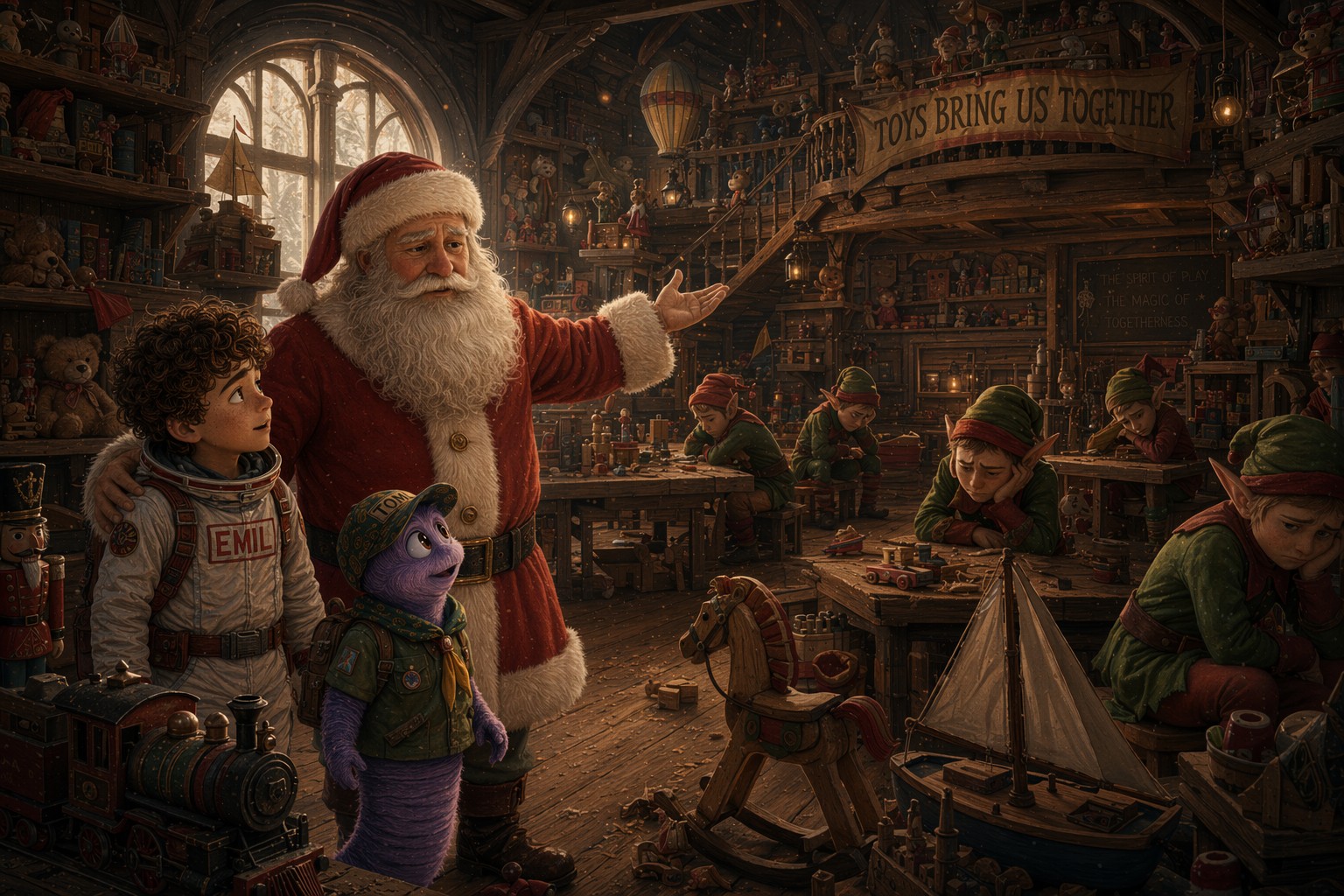
Santa Claus led Emil and Tom out of the cold and into his great workshop — and the moment they stepped inside, they understood his sorrow.
The workshop should have been a place of joyful chaos. Towering shelves lined the walls, packed with the most wonderful toys imaginable: hand-carved wooden trains, brightly painted spinning tops, kites and marbles and music boxes, building blocks and board games and rocking horses. There was a hammer for every elf and a workbench for every hand. By rights, it should have rung with hammering and laughter and song.
But it was silent. The toys sat on their shelves gathering dust. The workbenches were idle. And the elves — dozens of them — simply sat about, slumped and gloomy, their tools laid down, with nothing to do and no heart to do it.
"Once," Santa said quietly, gazing around at his silent workshop, "this place never stopped. Day and night, my elves built toys — the finest toys in all the universe — and on every winter's night I would load my sleigh and carry them across the stars, to children on a thousand worlds. And oh, the joy of it. To see a child's face light up at a new toy — to see them run outside and play, and share, and laugh together..." His voice trembled. "That joy was the magic that powered everything. But now..." He gestured at the dusty shelves. "Now the children don't want my toys anymore. And so my elves have nothing to build, and the magic is dying."
"But why?" Tom asked, bewildered. "Why wouldn't children want wonderful toys like these? Look at them — they're beautiful!"
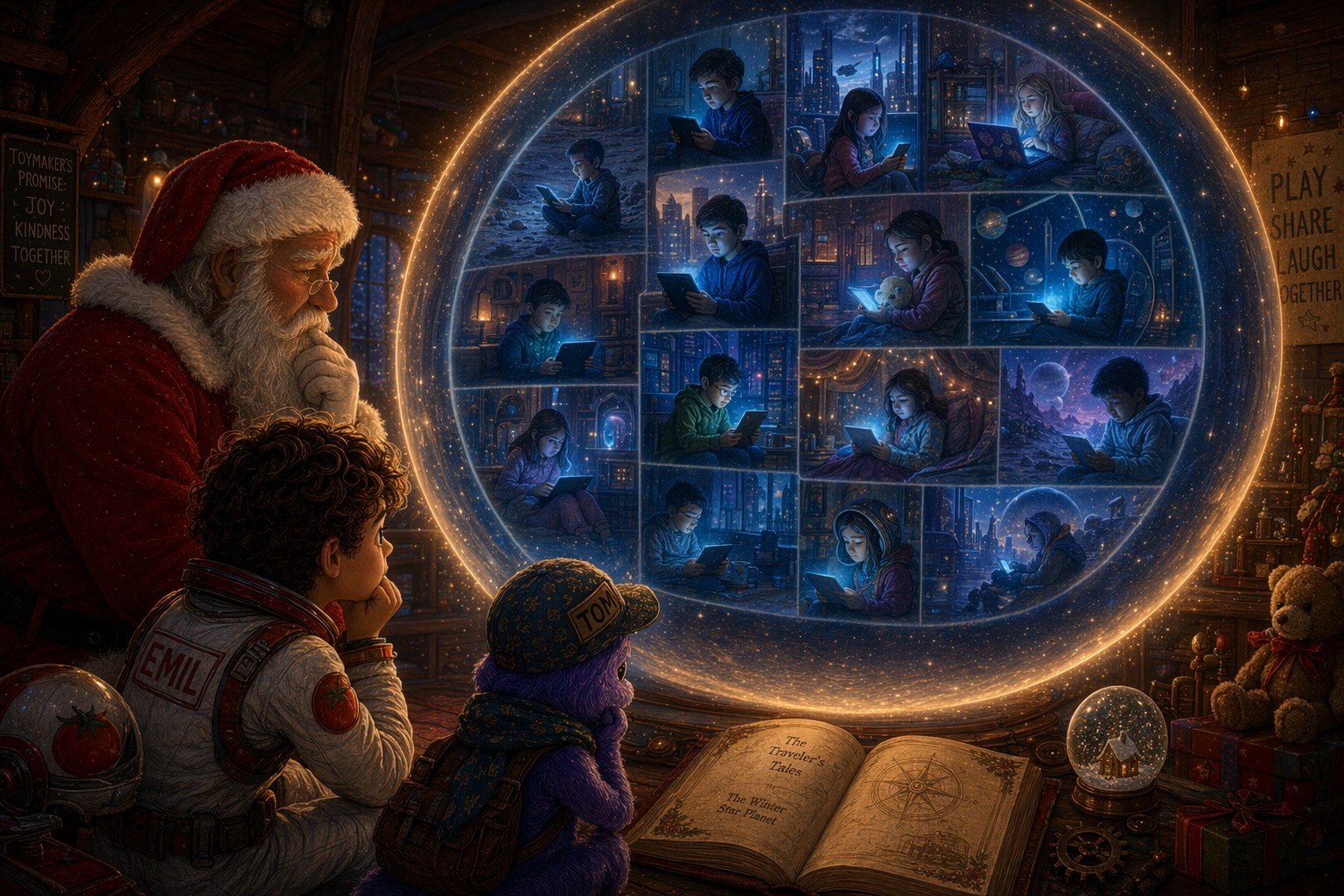
"Come," said Santa heavily. "I'll show you. We have a way of watching over the children — to know what they need. See for yourself."
He led them to a great glowing vision-globe in the center of the workshop — a magical window that could look out upon the children of any world. Santa passed his hand over it, and an image bloomed within: a child's bedroom on some faraway planet.
And there sat a little girl, all alone. She was hunched over a glowing screen, a flat little tablet of cold blue light, her face lit pale and blank, her thumbs tapping endlessly. She did not move. She did not smile. She did not look up.
Santa passed his hand again, and another scene appeared — a boy, alone in his room, also staring at a glowing screen. And another. And another. Child after child, world after world, each one alone in a separate room, each one hunched over a glowing rectangle, silent and still and solitary.
"This," Santa said softly, "is what's become of the children of the universe. They no longer play with toys. They no longer run outside. They no longer play together." He sighed deeply. "They sit alone, each in their own room, staring at little glowing screens, hour after hour after hour. The screens are clever — oh, terribly clever. They flash and beep and never let the children look away. And so the children forget how to play. They forget how to build, and imagine, and share. Worst of all..." His voice broke. "They forget each other. They sit alone, never knowing the simple joy of playing with a friend. And it breaks my heart, my boy. It truly breaks my heart."
Emil stared at the lonely children in the vision-globe, and felt a deep ache. "They look so... alone," he murmured. "And so sad, even though they don't seem to know it. There's no laughter. No friends. Just the screens."
"Screens aren't all bad, of course," Santa said. "They can teach, and connect, and delight, in their proper measure. But these children have lost all balance. The screens have swallowed everything else — the toys, the games, the friendships, the wonder. And a childhood without wonder, without friends to share it with..." He shook his head. "It's a poorer thing than it ought to be."
Then Santa led them to the back of the workshop, where something stood that made Emil and Tom catch their breath. It was a great crystal device, shaped like a many-pointed star, mounted on a pedestal — and it pulsed with a soft, magical glow. But the glow was weak, flickering, fading, like a candle guttering out.
"The Star of Wonder," said Santa. "The heart of Yuletide. It is powered by the joy and wonder of children at play — real play, shared play, the laughter of friends together. When children are full of wonder, it blazes bright, and it powers all the magic of my world: my sleigh, my workshop, the very star above our heads." He gazed at it sadly. "But as the children's wonder has faded — as they've traded play and friendship for lonely screens — the Star of Wonder has dimmed. And if it ever goes out..." He swallowed. "Then the magic of Yuletide ends forever. No more toys. No more sleigh. No more Santa Claus. And the children will lose the last little bit of wonder left in all the universe."
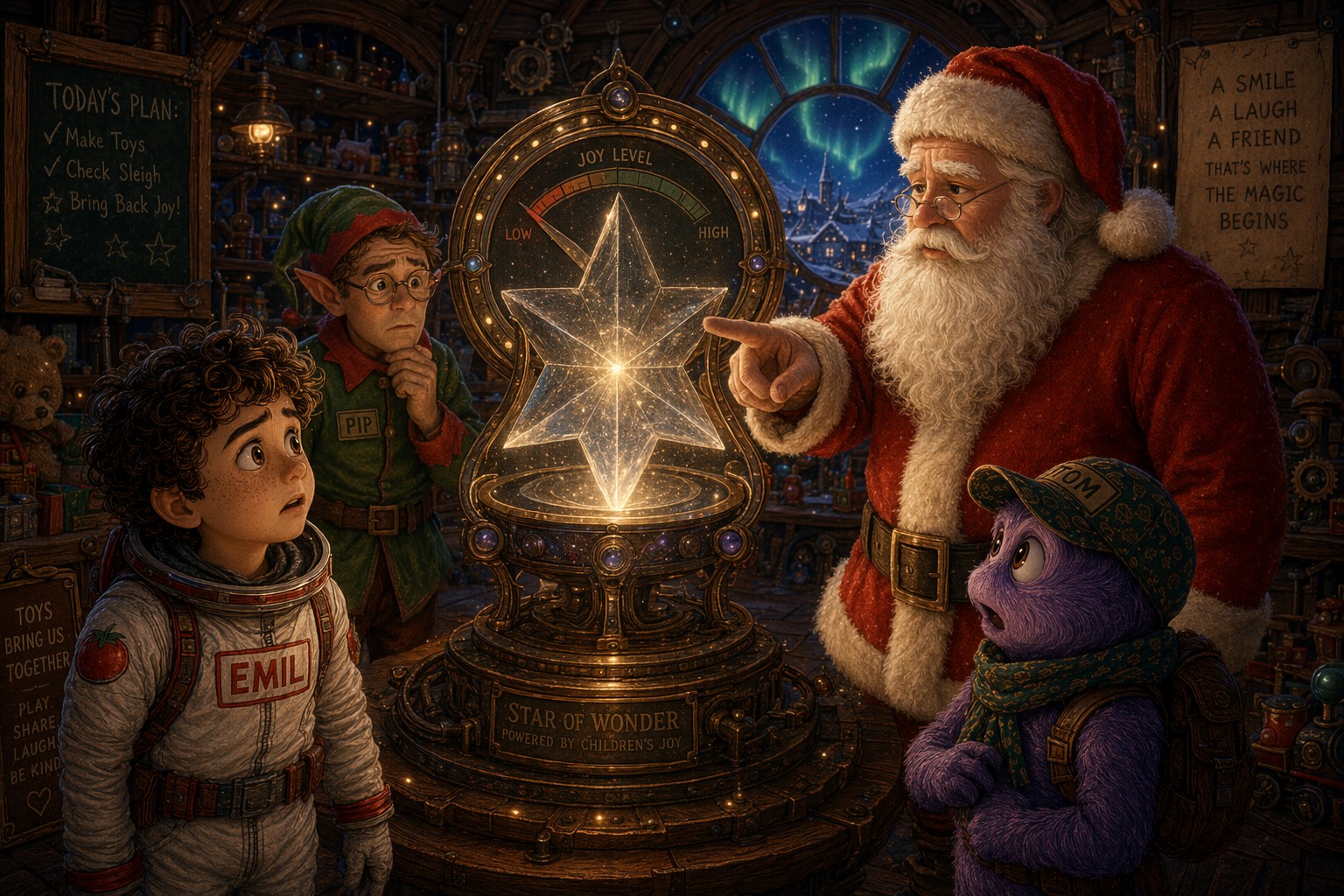
A small, clever-looking elf with a tool belt stepped forward — the head elf, it seemed. "I'm Pip, head of the workshop," he said, with a sad little bow. "We've tried everything, sirs. Built finer toys, brighter toys. But the children never even see them — their eyes never leave the screens. We don't know how to reach them anymore." He looked up, desperate. "The Star has maybe days left. Perhaps less."
Emil looked at the dying Star, at the dusty toys, at the lonely children in the globe — and a fierce determination rose up in him.
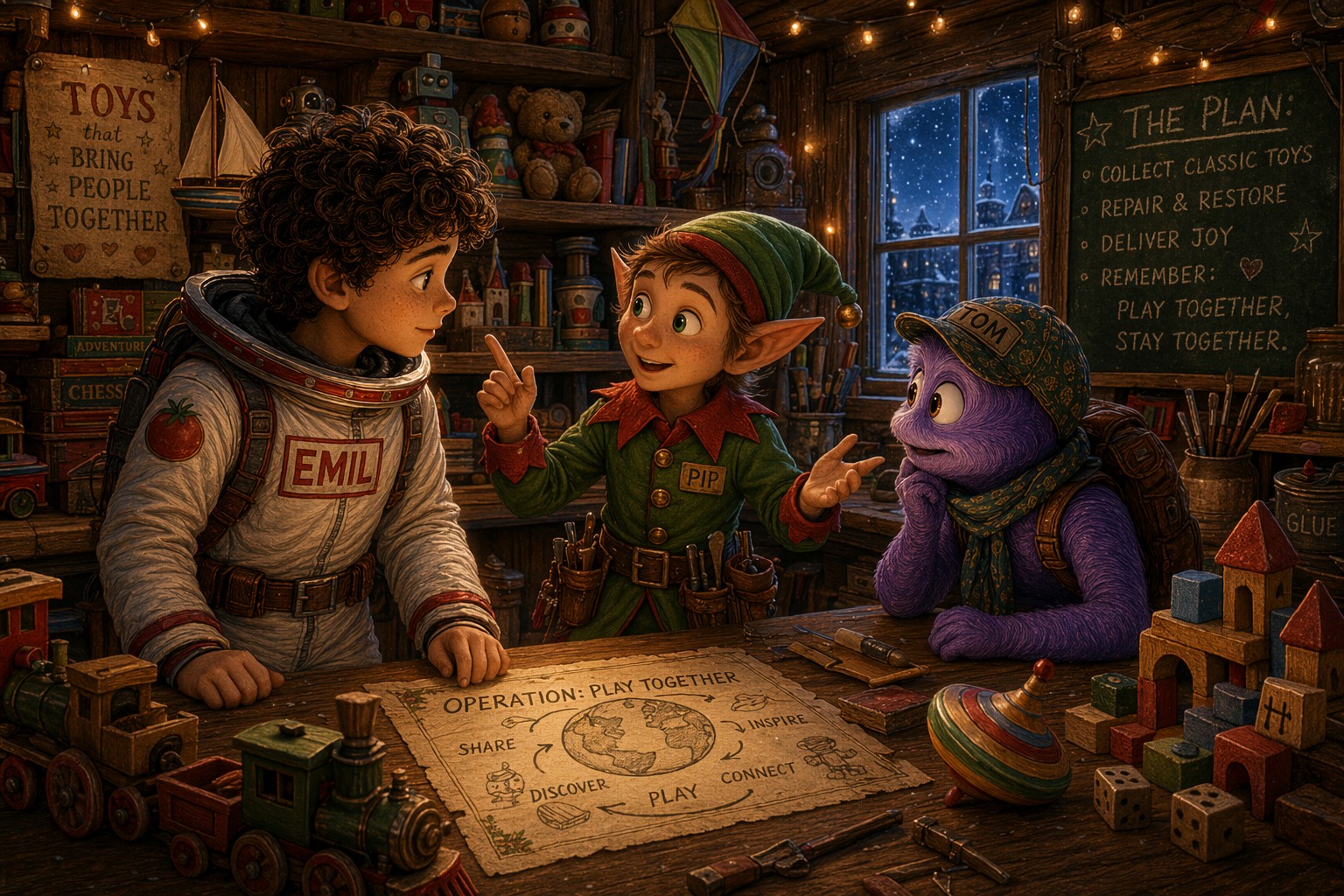
"Then we have to remind them," he said. "We have to remind the children of the universe what they've forgotten — the joy of real toys, and real play, and real friends. We have to bring the wonder back." He turned to Santa. "Santa — Tom and I have a ship. We can travel anywhere in the galaxy. Let us help you. Load our ship with your best toys, and we'll take them to the children ourselves. We'll show them what they're missing. We'll get them playing again — together."
Santa's old eyes filled with hope and tears. "You would do that? You would truly try?"
"We would," said Tom firmly. "Wouldn't we, Emil? We've saved planets before. We can save childhood itself!"
But just then, the vision-globe flickered, and a new image appeared — one that none of them had summoned. It was a slick, cold broadcast, the kind the children watched on their screens. A pale, sleek man in a shimmering silver suit smiled out of the globe with a thin, gleaming smile. Behind him glowed rows and rows of the addictive little screens, and above him hung a logo: a single, cold, unblinking eye.
"Greetings, children of the universe!" the man purred. "I am Mr. Vex, of Solo Industries. Why share, when you can have it all to yourself? Why go outside and get cold and muddy, when you can stay safe and cozy alone with your screen? Why bother with messy, difficult friends — when your screen gives you everything you need, all by yourself? Solo screens: everything you want. No one else required."
Santa's face darkened. "Him," he growled. "Mr. Vex. The one who makes the screens. He's grown rich and powerful selling loneliness to children, dressed up as fun. The more alone they are, the more screens he sells. He's the reason it's all grown so much worse, so much faster, these past years. He wants the children alone — because alone, they need him."
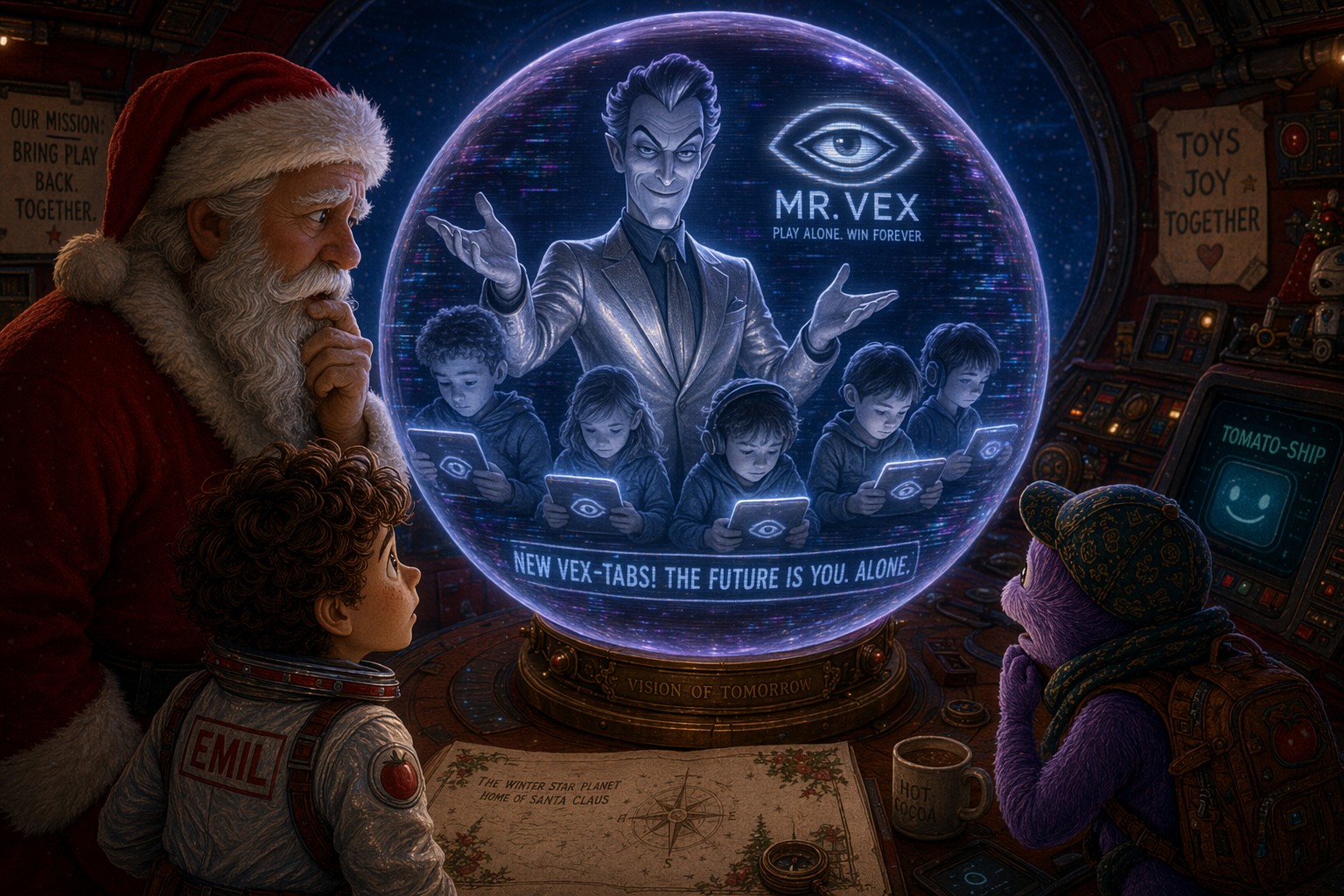
Emil's jaw tightened as he watched the smiling, silken villain in the globe. "Then he's exactly who we're up against," he said quietly. "Santa — load the ship. We're going to bring your toys to the children of the universe. And we're going to show them — and Mr. Vex — that there's something far more wonderful than any glowing screen." He looked at Tom, his eyes blazing. "The joy of playing together."
Outside, the great Star of Yuletide flickered weakly against the dark — and the race to save it had begun.
To be continued in Episode 3...